A decision simulation platform for strategists and brand leaders













Trusted by leading global brands







WHAT IS QLUE?
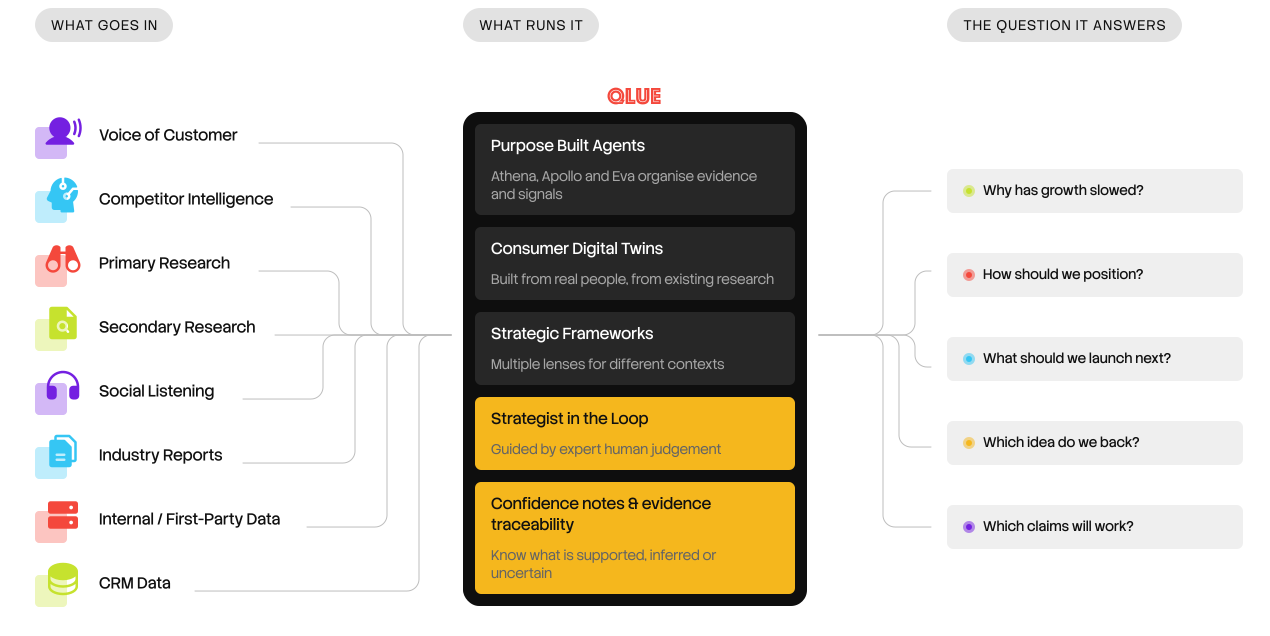
Qlue is an expert-driven, AI-powered simulation platform. It helps organisations make strategic product, marketing and growth decisions by leveraging existing data.


What Qlue helps you do
Qlue allows you to simulate a decision, so you know what deserves to be taken ahead. It does this by bringing together trusted source material, cutting-edge AI, purpose-built agents, evidence traceability and human expertise to simulate a decision - with proof.

Awards & recognition
Recognised by India’s leading market research body, in collaboration with The Third Eye Integrated Services.

Qlue on the road
We’ll be presenting at the annual conclave of global research professionals. Come say hi!
Case studies
Questions Qlue has helped answer
How Qlue has helped teams explore high-stakes questions using data, simulation and expert judgment.



meet the founders
Who’s building Qlue
Qlue is led by Sushma Panchawati and Ravi Bhim, a founder duo working across strategy, research, AI and product design. Their shared belief is that complex business questions need technology, but they also need human judgment, context and taste. Qlue is built around that balance.


Our Blog
Qlue In
We’re opinionated about how AI and technology more broadly can assist human creativity and strategy-making. This space will act as an outlet for us to share our thinking.


FAQs
Enterprise AI like Microsoft Co-pilot or GPTs are powerful general-purpose AI platforms. Teams use them to summarise, draft, analyse, plan and work across business files.
Qlue is built for one specific job: simulating strategic decisions.
Here is how the two differ.
General purpose Enterprise AI platforms work with the context and files you give it in the moment. Qlue builds a curated intelligence layer from your research archives, internal data, market signals and cultural context, so every question is answered from an evidence base.
General purpose Enterprise AI platforms can roleplay a consumer if you prompt well. Qlue builds Digital Twins from actual source material, at individual or segment level, so consumer responses are grounded in real research.
With Enterprise AI, the quality of strategic output depends on how well the user prompts and reviews it. Qlue comes with strategic frameworks, specialised agents and expert-in-the-loop workflows built in.
Enterprise Ai platforms can produce strong answers, and confidence depends on the prompt and the review process. Qlue is designed to show you what is supported by evidence, what is inferred, what is uncertain and what needs validation.
In short: use Enterprise AI platforms for broad AI adoption across your organisation. Use Qlue when you have a high-stakes strategic question where evidence, context and judgement need to work together. Many of our clients use both.
Yes. Client data is confidential and processed in secure, isolated project environments. One client’s research, data, outputs or learnings are not shared with another client, used in another project, or used to train Qlue or base LLM models.
In practice, this means:
- GDPR-aligned handling of personal information: Personal identifiers can be removed at input, and digital twins are created from anonymised, relevant source material rather than exposed personal data.
- Project firewalls: Each engagement is kept separate, so client data, source material, outputs and learnings remain within that project environment.
- No LLM training on client data: Your data is not used by Qlue or by base LLMs to train their models. Qlue uses privately hosted LLMs to avoid this risk.
For enterprise engagements, specific hosting, access, security and compliance requirements can be discussed during onboarding.
A synthetic persona is often generated from broad public data, general assumptions or category-level averages.
A Qlue Digital Twin is built from brand-specific, internal source material connected to a specific problem, brand, category or audience. These twins have a lot of depth and detailed data points, allowing them to be more useful for company-specific questions where generic consumer logic is not enough.
Synthetic personas approximate a consumer. Qlue Digital Twins extend the usefulness of past consumer research.
We work with clients at 3 levels:
- Done For You: Either Qlue or your preferred agency partners can run projects on the Qlue platform and deliver white glove service for specific briefs.
- DIY: We provide platform access for your teams to run queries on Qlue.
- A combination: We create twin panels that can be used DIY or in service mode based on the complexity and need.
The best results come when there is a clear business question, relevant source material and strategic guidance. That guidance may come from your internal strategy, insights, innovation or brand team. It may come from an existing strategy partner. Or it may come from Qlue’s own team and partner network.
If you do not already have a strategy partner, Qlue can help shape the engagement around the problem you are trying to solve. The strategist remains in the loop: framing the question, choosing what matters, challenging outputs and deciding what becomes a recommendation.
Projects priced by scope, panels priced as setup plus ongoing access, longer engagements with a six-month minimum.